
NextGen Palates & Perspectives Panel & Tasting
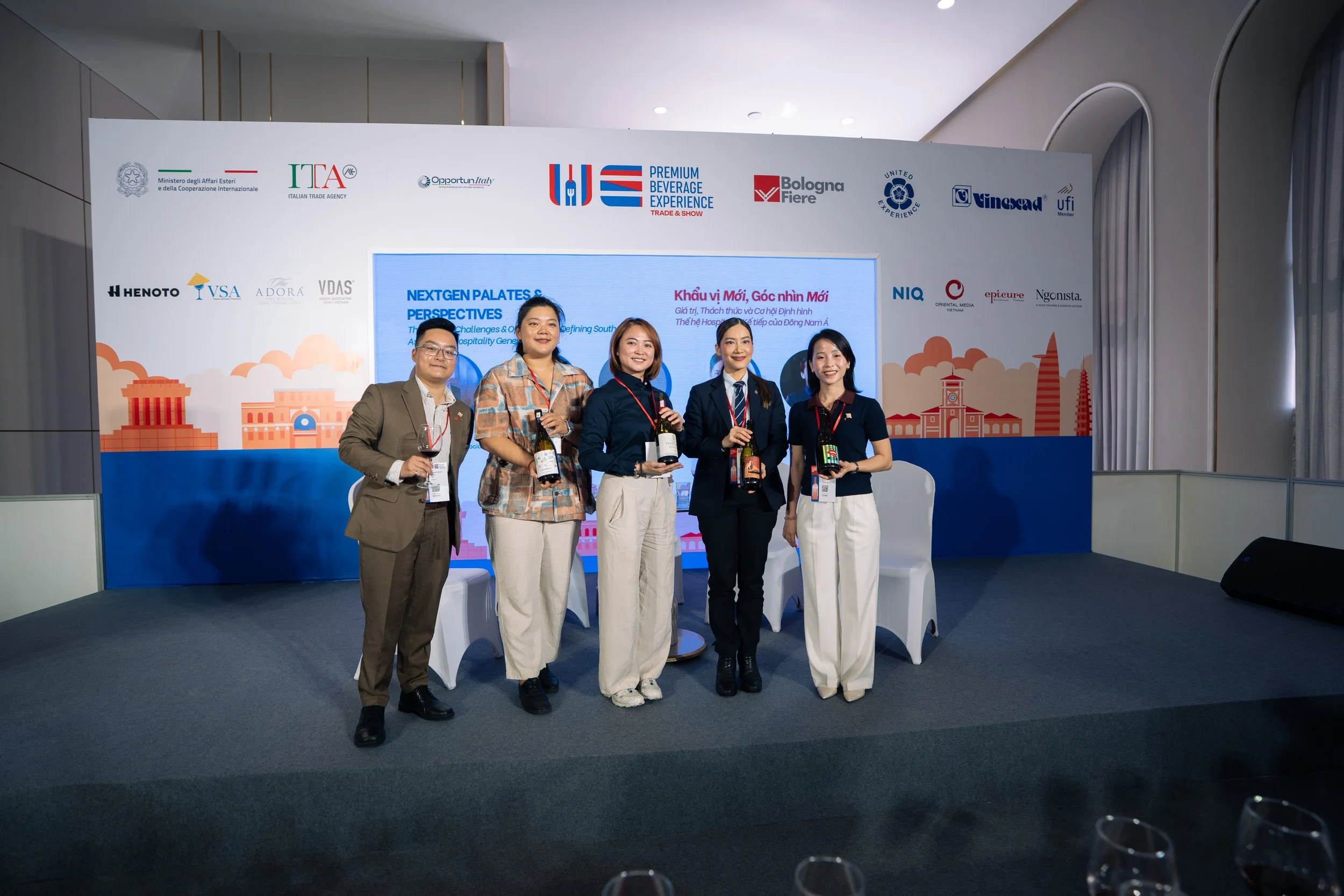
NextGen panel, moderated by Khan Vi Le Hoang who was joined by Minyoung Ryu, Happy Gan, Atchara “Apple” Wongthai Palleros and Trâm Tran
When we talk about the future of wine in Southeast Asia, it is easy to fall back on broad ideas: younger consumers, growing cities, new hospitality concepts. At Wines Experience Ho Chi Minh City, we wanted to make that conversation more concrete. Who are these new consumers? What are they actually ordering? How do they learn about wine, and what makes them return to a bottle after the first taste?
That was the purpose of The Next Generation Wine Consumer in Southeast Asia, held on June 26 at The ADORA Center. We brought together five women working directly across four different markets, each with a close view of what happens between the wine list and the customer.
The session was moderated by Khan Vi Le Hoang, Vice-President of the Vietnam Sommelier Association and Beverage Director at Nén restaurants. She was joined by Minyoung Ryu, Head Sommelier at Potato Head Family in Bali; Happy Gan, Business Development Manager at DC Selections in Kuala Lumpur; Atchara “Apple” Wongthai Palleros, Wine Training Manager at Central Food Retail in Thailand; and Trâm Tran, Vice-President of the Vietnam Sommelier Association in Hanoi. Their roles span restaurants, retail, distribution and education, which meant the discussion stayed close to the realities of selling and serving wine in the region.
A new consumer shaped by travel, lifestyle and curiosity
One of the first points to emerge was the role of international exposure. In Vietnam and Malaysia, many younger wine drinkers have studied, lived or travelled abroad and returned with a more familiar relationship with wine. They are integrating it into social occasions, restaurants and home consumption rather than treating it only as a formal or celebratory purchase.
The same generation is also paying closer attention to how drinking fits into the rest of their lifestyle. In Thailand, Apple is seeing more interest in lower-alcohol wines, lighter styles and quality over volume. In Bali, tourism and a large international community have created an audience that is particularly open to unfamiliar grapes and new styles, even though high import taxes continue to push wine into a premium price range.
These differences matter because Southeast Asia cannot be approached as one single market. Hanoi, Ho Chi Minh City, Kuala Lumpur, Bangkok and Bali may share some trends, but the reasons people buy wine, and the occasions in which they drink it, remain local.
From prestige to something people can actually enjoy more often
The panel described a clear change in the way younger consumers judge wine. Recognisable labels and heavy, oaked reds once carried an immediate sense of status. Today, more buyers want to understand why a bottle deserves their attention, while also looking for wines they can afford to enjoy more regularly.
That shift is supporting fresher, lighter and more approachable styles. In Thailand, the retail market is seeing greater interest in everyday wines for home consumption. In Malaysia, natural wine helped make the category feel less formal after the pandemic and later opened the door to wider conversations around organic, biodynamic and low-intervention production. Vietnam is still earlier in this journey, but education is gradually loosening the idea that wine belongs only to foreigners, luxury settings or major celebrations.
Education has to work in front of a real customer
Another important part of the session focused on the people introducing wine to this new audience. The panelists agreed that technical knowledge still matters, but it has to be translated into something useful at the table.
Apple explained that she trains wine professionals by putting them into realistic customer situations early. It quickly shows the difference between knowing a fact and being able to use it. Happy Gan spoke about the value of recognised qualifications in an emerging market, where certifications can give consumers confidence in the person recommending the bottle. Minyoung and Vi also addressed the growing use of AI in wine education: the tool can speed up research, but students still need to verify information and develop their own judgement.
The same principle applies when speaking to guests. Technical vocabulary can easily create distance, while familiar flavours, personal experiences and simple comparisons make the wine easier to remember. Trâm, for example, uses the similar long, narrow shapes of Italy and Vietnam to help local customers place Italian regions geographically. It gives them a framework they already understand and makes unfamiliar denominations feel less remote.
Four wines, four ways of entering the conversation
Mmmm…Enjoy Prosecco Extra-Dry Millesimato, presented by Trâm, represented one of the world’s most familiar sparkling categories. At the same time, its playful label immediately communicated something relaxed, approachable and fun. That first visual impression is important, especially for a younger consumer deciding among unfamiliar bottles.
Tenuta delle Terre Nere Etna Rosso, presented by Happy Gan, showed how an unfamiliar wine can be introduced through a useful point of reference. Its refined tannins, acidity and aromatic profile share some qualities with Nebbiolo, a grape many experienced drinkers already recognise. That comparison creates an accessible entry point before the conversation moves toward Nerello Mascalese, altitude and Etna’s volcanic soils.
With Varvaglione Susumaniello, presented by Minyoung, the appeal went beyond its medium body, light tannins and compatibility with food. Susumaniello is an indigenous Puglian variety being revived by the next generation of the Varvaglione family. That made it especially relevant to the discussion: it connects the growing interest in native grapes with a new generation of producers taking responsibility for local identity.
The wine shows how tradition can become even more relevant when it is presented through the people continuing it. For a customer, discovering an unfamiliar grape becomes easier when the story includes a family, a place and a clear reason why the variety matters today. Its approachable style then does the rest of the work at the table.
Apple closed the tasting with Paltrinieri “Solco” Lambrusco Salamino. At 11% alcohol, this wine brought together several of the qualities discussed throughout the session like the moderate strength, the immediate pleasure and the ability to work with food.
Why this conversation matters to us
We created this session because understanding the next generation requires more than demographic data. It requires listening to the people who recommend wines every day, train hospitality teams, build portfolios and watch customers make decisions in real time.
So overall we can say that younger consumers are interested in wine, but they expect it to be easier to understand, more relevant to their lifestyle and connected to a genuine experience. They respond to lighter styles, lower alcohol, sparkling wines and stories that feel personal rather than rehearsed. At the same time, they are asking better questions about producers, methods and what sits behind the label.
